Recycling Plastic
There’s so much plastic around – everywhere! Let’s face it, it’s actually quite useful stuff so we’ll probably never be rid of it. It’s great to hear that there are some clever people developing new tech to help to solve the plastic crisis, but as with all climate crisis issues, we need to tackle the problem from multiple levels.
When we talk about recycling now, we really mean the 4 R’s : Remove – Reduce – Reuse – Recycle. It’s all about using the planet’s resources more efficiently.
How Can I Reduce Plastic?
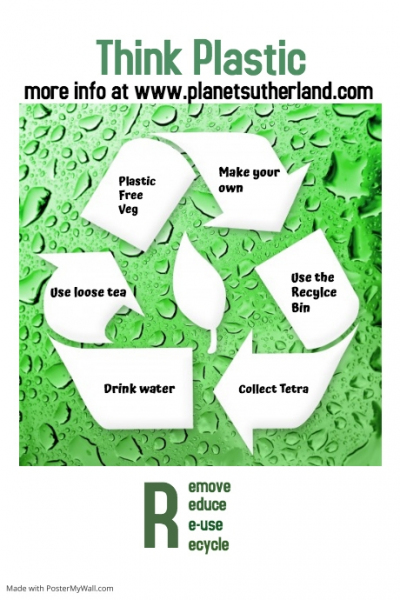
What can you Remove? This doesn’t mean remove now – it’s meant to get us thinking of whether we needed the thing in the first place – buy less stuff – or buy stuff that’s not plastic or wrapped in plastic.
What can you Reduce? Perhaps you can buy in bulk or share things with neighbours and friends.
Reusing follows along nicely. Take plastic containers along to shops for refilling. Reuse cheese packing or bread wrappers for storing food. I can’t remember when I last bought sandwich or freezer bags, for instance.
If all else fails – Recycle. But before you put something in your blue bin or take it to the (soon to be open recycle centres) – can you recycle it another way? Old laptops can be rejuvenated, toys can be shared with other children (gosh COVID does complicate things!!)
Let’s start with:
Project Plastic!
Here’s a plan to reduce plastic in your life. Think of it as a project. Pick one room in the house each week to focus on and write down the plastic that you see. Plastic Free July is a worldwide campaign to reduce our dependence on single use plastic. Covid has made this significantly more difficult – more bread is wrapped, more fruit is wrapped and LIDL are now providing plastic bags to use to pick bread and cake products instead of tongs: Anyone up for a weekly challenge to support this?
Set up your own Project Plastic. For four weeks, pick one room in the house and see what you can do to reduce plastic.
Reducing Plastic in the Kitchen
A quick tour of the kitchen can provide ideas like:
- Plant your own coriander or buy grown instead of plastic wrapped.
- Grow your own chillis.
- Just ditch the crisps, or cut back. It’s much easier to do that than continually think about how to recycle the plastic.
- Eating more home made soup for lunch cuts down on bread and bread bags
- Look out for fruit and veg packaging. Check if it’s compostable. Or pick food that’s unpackaged.
- Use rag cloths instead of kitchen roll.
- Make your own yoghurt.
- Make your own bread and naan bread.
Reducing Plastic in the Bathroom
- Buy recycled toilet roll in bulk without plastic
- Use shampoo bars and go back to using soap, or refill your containers (not many shops around here doing refills yet)
- Try making your own cleaning products
- And there are feminine hygiene product alternatives too.
- Please pop over to the Facebook group to share your hints and tips for saving plastic use in the bathroom. Here are some ideas: use shampoo bars and bars of soap instead of shower gel. How about deodorant made with corn flour? Toothpaste can be replaced by tooth cleaning “pills” that you melt in your mouth and then brush.
Reducing Plastic in the Garden
There’s a great group Our Food, Our Land: Gardeners Responding to Climate Emergency which has been discussing how to reduce plastic in the garden. And of course, there are lots of sites around from Gardeners World to the BBC and Garden Organic who all have pages on how to reduce or reuse garden plastic.
Many solutions, as usual may be ok for cities and more densely populated areas. Here are some thoughts and ideas on garden plastic:
-
Dobbies do take back cleaned plant pots and trays for recycling.
-
Compostable pots and trays are now available, although no doubt a little more expensive
-
Pots can easily be made from toilet roll tubes (you can cut and fold over one end to stop compost coming out of the bottom
-
And of course some plants like peas and beans can be started off in toilet roll tubes and planted straight in the garden (helps to deter mice eating them, and allows earlier starting indoors)
-
Compost (bark, grit, feed.. ) bags seem to be the worst problem. No one, it seems, takes these for recycling. It’s a big problem and crosses over into other plastic bags like pet food bags, bird food bags etc. If you look on line, you can see many suggestions – lining raised beds and planters – use them for rubbish bags – weed suppression on paths (I worry about what happens when they degrade…)
-
More on compost bags… One suggestion – BAD – was to take the bag and fill it with appropriately mixed composting material and seal the bag tight. This is bad because anaerobic composting makes methane, which is really bad for global warming.
Be great to hear your ideas on how we can reduce the areas garden plastic use. So, please do join the us to share your fab ideas on how to reduce our garden plastic problem – which, ironically, will most likely get worse as more of us are “growing our own”.
Reducing Plastic in our Kids Lives
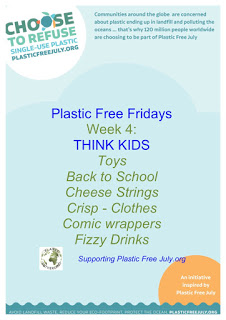
WOW, it’s amazing when we think of how much plastic can be in our kids lives.
Drinks: from fizzy drinks to fruit shoots or even small bottles of water.
Food: cheese strings, baby-bell, pre-prepared packs of fruit, crisps, sweeties, yoghurt, ice cream…
Special meal packs: toys in the kiddie meal packs or plastic toys in cereal boxes…
Clothes: fleece is great for quick washing, but leaches plastic into the water
Toys: are there any toys not made of plastic now adays?
Back to School: pencil cases, school bags, lunch boxes, folders
Comics: mostly wrapped in plastic these days, with free plastic toys…
Reducing Plastic in rest of the house
It would be interesting to calculate the reduced carbon foot print that’s arisen from stopping using physical CD’s and DVD’s. Do we really need a new TV? Can the older computer be reused? Can the vacuum be repaired?
Why not join our Facebook Group to see what we can all to do reduce the plastic in our lives and join up with Plastic Free July.
Read more about our Refuse, Reduce, Reuse, Recycle plans here.